Explore the 2026 revolution in pipe stress analysis. Learn how Agentic AI integrates with CAESAR II to perform Generative Support Optimization, navigating the 2024/2025 ASME B31.3 updates and B31J SIF requirements autonomously.
In the 2026 engineering workflow, pipe stress analysis has undergone its most significant evolution. Today, the rise of Pipe Stress 4.0—powered by Agentic AI—has replaced the reactive iterative cycle with Generative Support Optimization. AI agents now act as a bridge between the 3D model and the stress kernel, autonomously proposing configurations that satisfy [ASME] requirements.
This post explores the technical integration of autonomous agents with industry-standard tools like CAESAR II. We examine how AI handles complex scenarios—such as high-temperature creep and seismic cycles. For professionals specializing in [Pipe Stress Engineering, Static], this shift represents a transition from performing the calculation to defining optimization criteria. In 2026, the value of the stress engineer lies in their ability to orchestrate these systems to create self-solving piping networks.
1.0 The Evolution of Stress Engineering
1.1 Why Traditional Analysis is the 2026 Bottleneck
The global shift toward rapid infrastructure deployment has rendered manual stress analysis obsolete. Manually iterating through support types can add months to a project schedule. Furthermore, human-driven approaches often lead to over-engineering. AI agents utilize reinforcement learning to explore thousands of support permutations in seconds. While a junior engineer might struggle to balance flexibility and rigidity, the AI agent performs simultaneous constraint satisfaction. Mastering physics is still essential, as taught in [Pipe Stress Engineering-Academic foundation], but execution is now at machine speed.
1.2 Generative Support Optimization
In 2026, we no longer draw supports; we generatively propose them. When a routing agent finalizes a run, a Stress Agent immediately analyzes the span. It references standard libraries and, using logic from [Pipe Stress Engineering, Advanced], places hangers that minimize nozzle loads. By the time a lead reviews the model in the [Professional Piping Lead Engineer] hub, the AI has already verified spring sizing and cold-vs-operating load balances.
2.0 The AI-CAESAR II Bridge
2.1 Automated Model Generation
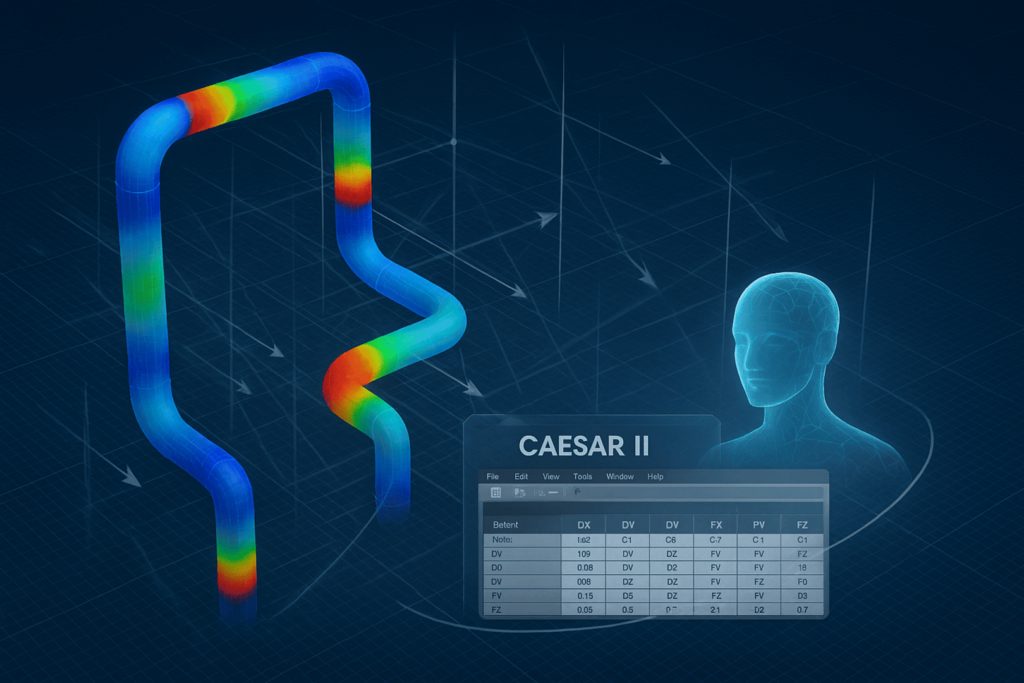
Integration between AI and CAESAR II is seamless in 2026. Agents use direct API access to build models from the 3D environment, eliminating transcription errors. This allows for massive sensitivity testing. For engineers taking the [B31.3 Process Piping] course, this means focusing on the interpretation of results identifying if a design is too sensitive to installation tolerances rather than manual data entry.
2.2 AI-Driven Fix Recommendations
When an analysis fails, the agent acts as a senior consultant. It provides a fix roadmap citing specific code paragraphs. If a joint exceeds allowable stress per ASME B31.3 (2024), the agent analyzes the stress type and proposes specific changes. This bridge between raw data and code compliance allows firms to maintain a high right-first-time ratio, as taught in [Pipe Stress Engineering, Static].
3.0 Integrating B31J and 2024 Code Updates
A major technical hurdle has been the universal adoption of ASME B31J. AI agents automatically identify fittings, query B31J, and apply precise factors. It also handles the 2024 Sustained Stress Index requirements autonomously. For those preparing for the [Ultimate ASME B31.3 Practice Exam], seeing these agents in action masterclasses how modern standards are applied. The AI handles the math, while the engineer focuses on methodology.
4.0 Conclusion
The integration of Agentic AI with CAESAR II has evolved the stress engineer’s role. The analyst is now an AI Director. Continuous learning is vital; the future is one where piping systems know their stress state and predict maintenance needs. By mastering advanced tools, you prepare to lead this revolution in an industrial landscape defined by intelligence and speed.