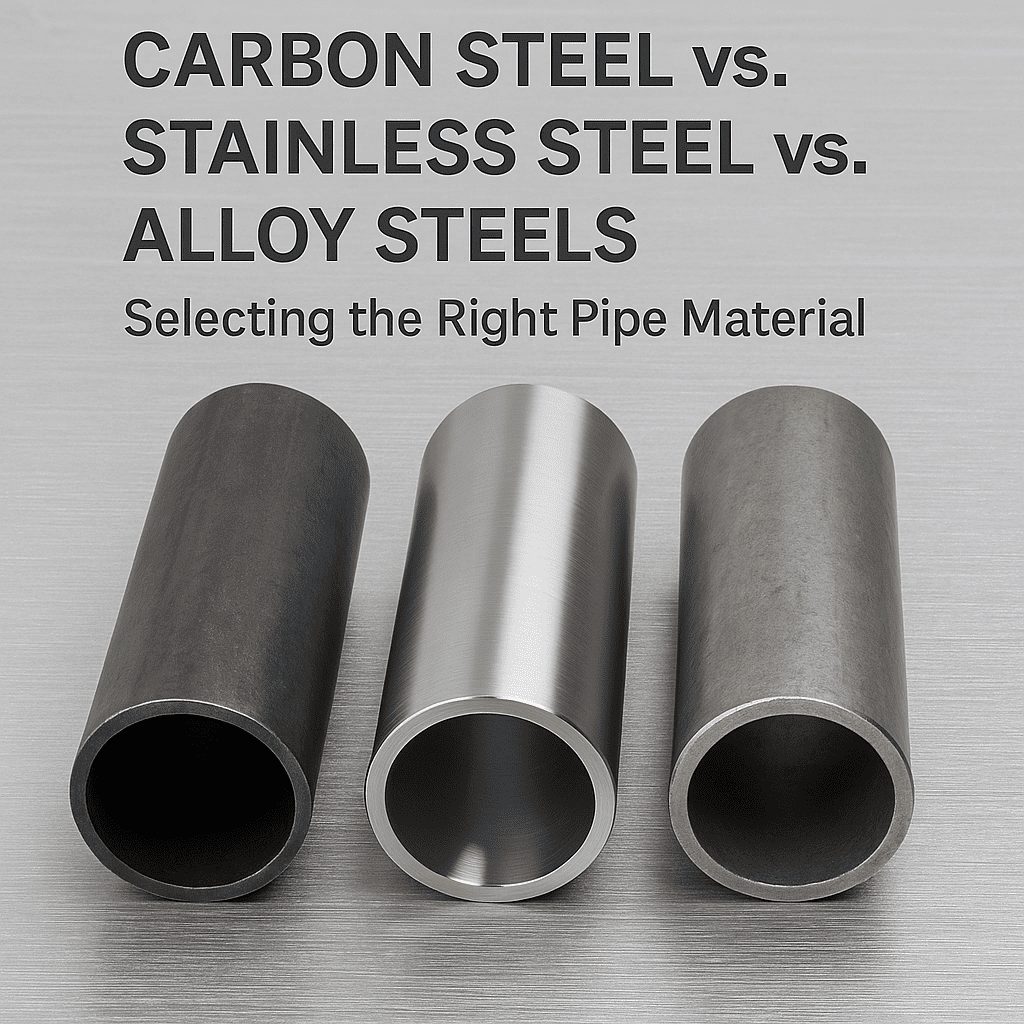
- Introduction: Material selection as a cornerstone of piping design. Balancing performance, cost, and safety. Overview of the main metallic piping material families.
- Carbon Steels: The workhorse of the industry.
- Composition: Primarily iron and carbon (typically < 2.1% C), with small amounts of manganese and other elements.
- Common Grades (ASTM/ASME):
- ASTM A106/ASME SA-106 (Seamless): Grades B, C. For high-temperature service.
- ASTM A53/ASME SA-53 (Seamless & Welded): Grades A, B. General purpose pipe.
- API 5L (Seamless & Welded): Grades B, X42, X52, X60, X65, X70, etc. For line pipe.
- ASTM A234/ASME SA-234 WPB, WPC (Fittings).
- ASTM A105/ASME SA-105 (Forgings - Flanges).
- Properties: Good strength, ductility, weldability, relatively low cost.
- Advantages: Economical, readily available, well-understood behavior.
- Limitations: Prone to corrosion (rusting) in many environments, limited high-temperature strength (creep becomes an issue above ~427°C/800°F), susceptible to brittle fracture at low temperatures (unless specifically manufactured for low-temp service, e.g., A333).
- Typical Applications: Water, steam, oil, gas (non-corrosive or with inhibitors), structural supports.
- ASME B31.3 Considerations: Widely used, with allowable stresses listed in Appendix A. Carbon equivalent for weldability.
- Stainless Steels: For corrosion resistance and/or high/low-temperature service.
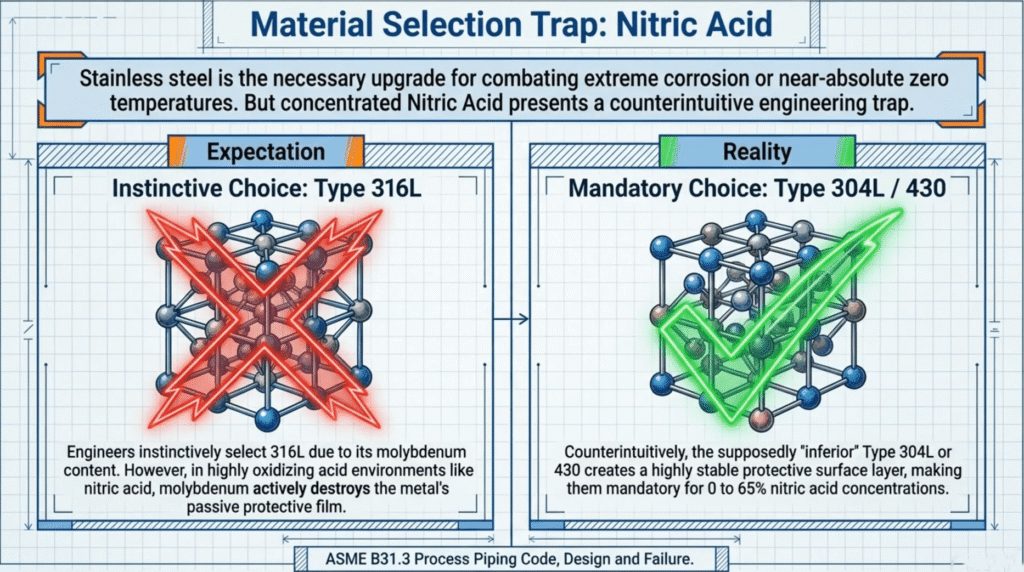
- Composition: Iron-based alloys containing at least 10.5% Chromium, which forms a passive protective layer. Nickel, Molybdenum, and other elements are added to enhance properties.
- Main Types & Common Grades (ASTM/ASME):
- Austenitic (e.g., TP304/304L, TP316/316L, TP321, TP347 - from A312/SA-312): Most common, good corrosion resistance, excellent ductility and formability, good high-temp strength and low-temp toughness. Non-magnetic. 'L' grades (low carbon) for better weldability and resistance to sensitization.
- Ferritic (e.g., TP405, TP430): Good corrosion resistance (especially to chloride SCC), magnetic. Less ductile than austenitics.
- Martensitic (e.g., TP410): Can be hardened by heat treatment, high strength, moderate corrosion resistance. Magnetic.
- Duplex (e.g., 2205, 2507): Mixed austenitic-ferritic microstructure. High strength, excellent resistance to chloride SCC and pitting.
- Advantages: Excellent corrosion resistance in specific environments, good appearance, hygienic.
- Limitations: Higher cost than carbon steel, can be susceptible to specific corrosion forms (e.g., chloride stress corrosion cracking for austenitics).
- Typical Applications: Chemical processing, food & beverage, pharmaceuticals, marine environments, cryogenic service (austenitics), high-temperature service.
- ASME B31.3 Considerations: Extensive use, specific rules for different types, allowable stresses in Appendix A. Welding considerations can be more complex.
- Alloy Steels: Enhanced properties for demanding conditions.
- Composition: Steels alloyed with elements other than carbon (e.g., Cr, Mo, Ni, V, W) to improve strength, toughness, creep resistance, corrosion resistance, or hardenability.
- Low Alloy Steels (e.g., Chrome-Moly Steels):
- Grades (ASTM A335/ASME SA-335 for pipe): P1, P5, P9, P11, P22, P91, P92. These have varying Cr and Mo contents.
- Properties: Improved high-temperature strength (creep resistance) and sometimes better corrosion/oxidation resistance than carbon steel.
- Applications: Power plants (steam lines), refineries (high-temp process lines). P91/P92 are advanced creep strength enhanced ferritic (CSEF) steels requiring very careful fabrication and heat treatment control.
- High Alloy Steels: (Stainless steels are a subset). Others include nickel-based alloys (often not called 'steel').
- ASME B31.3 Considerations: Critical for high-temperature design. Specific preheat and Post-Weld Heat Treatment (PWHT) requirements in ASME B31.3 Chapter V are vital, especially for Cr-Mo and CSEF steels. Allowable stresses in Appendix A.
- Factors Influencing Material Selection (Reiteration): Fluid handled, pressure, temperature (min/max), corrosion concerns, mechanical strength, toughness, cost, availability, weldability.
- Conclusion & Call to Action: Choosing the right piping material is a complex decision with significant safety and economic implications. A deep understanding of material properties, advantages, limitations, and relevant ASME B31.3 (Chapter III on Materials, and Appendix A) requirements is essential. In-depth courses on metallurgy, corrosion, and material selection specifically for piping applications empower engineers to make informed choices that ensure long-term system integrity.