Neglecting flexibility analysis is a recipe for equipment failure. Learn how to identify when your system requires formal stress calculations under ASME B31.3 Section 319.4.1.
0.0 Introduction
0.1 Pitfall #2: The Hidden Risks of Insufficient Piping Flexibility Analysis
In process piping, heat is both a tool and a threat. As temperatures rise, steel expands, and without adequate flexibility, that expansion translates into massive forces on equipment nozzles and supports. Pitfall #2 in ASME B31.3 compliance is the failure to perform a formal flexibility analysis when required. Many engineers rely on ‘visual judgment’ or ‘experience,’ but the Code is clear: if a system does not meet specific criteria, a formal calculation is mandatory.
1.0 When Does a System Require Formal Analysis? (H2)
1.1 B31.3 Requirements for Stress Calculations (H3)
Section 319.4.1 of ASME B31.3 provides the ‘No Formal Analysis’ rule. However, the conditions to satisfy this rule are strict. If your piping system has a complex geometry, large diameter, or high temperature, you likely fall outside this exemption. Misinterpreting this section is a frequent audit failure.
1.2 Common Thermal Expansion Errors (H3)
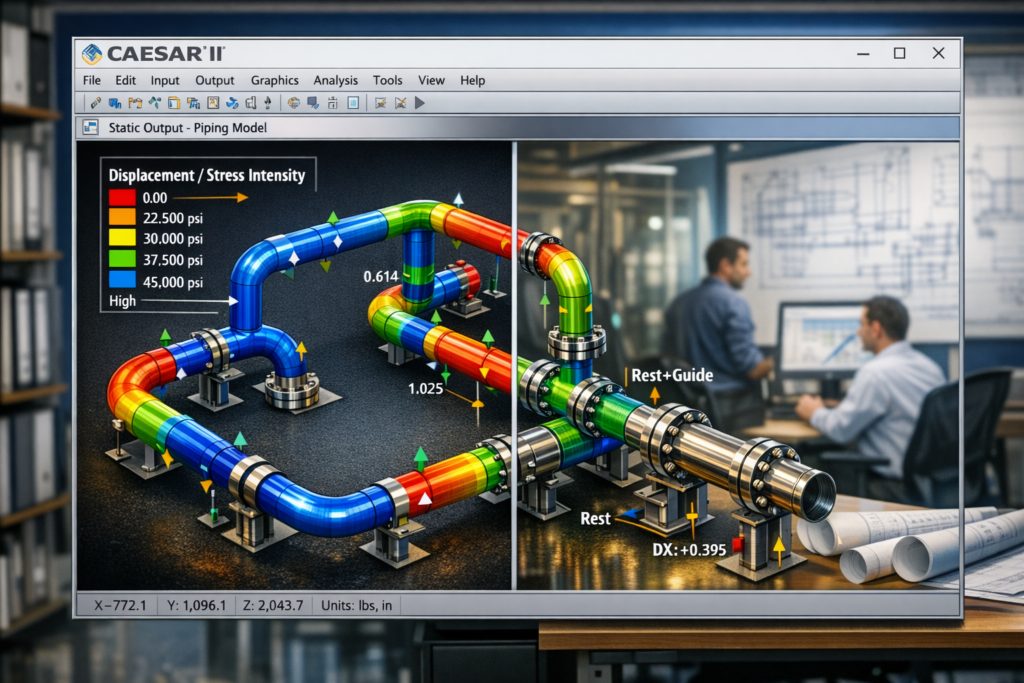
A common error is neglecting the ‘Stiffness’ of the system. Even a small thermal change in a short, stiff run of high-schedule pipe can generate loads exceeding the allowable limits of API 610 (for pumps) or API 617 (for compressors). Verification through Pipe Stress Engineering, Static software like CAESAR II or ROHR2 is the only way to prove compliance.
2.0 Optimized Supporting Systems (H2)
2.1 Correct Use of Spring Hangers and Bellows (H3)
When flexibility cannot be achieved through geometry alone, resilient supports become necessary. However, improperly selected spring hangers can actually introduce more stress into a system if not sized for both ‘hot’ and ‘cold’ conditions. Compliance requires following the guidelines in Piping Flexibility and Support.
Recommended Training Courses
FAQ Section
- What is the ‘No Formal Analysis’ rule? It is a simplified equation in B31.3 used to determine if a system is flexible enough to waive computer-based calculations.
- Can I use expansion joints to solve all flexibility issues? They are effective but introduce maintenance and pressure thrust concerns; they should be used only when loops are not feasible.
- What software is best for B31.3 stress compliance? CAESAR II is the industry standard for static and dynamic analysis.