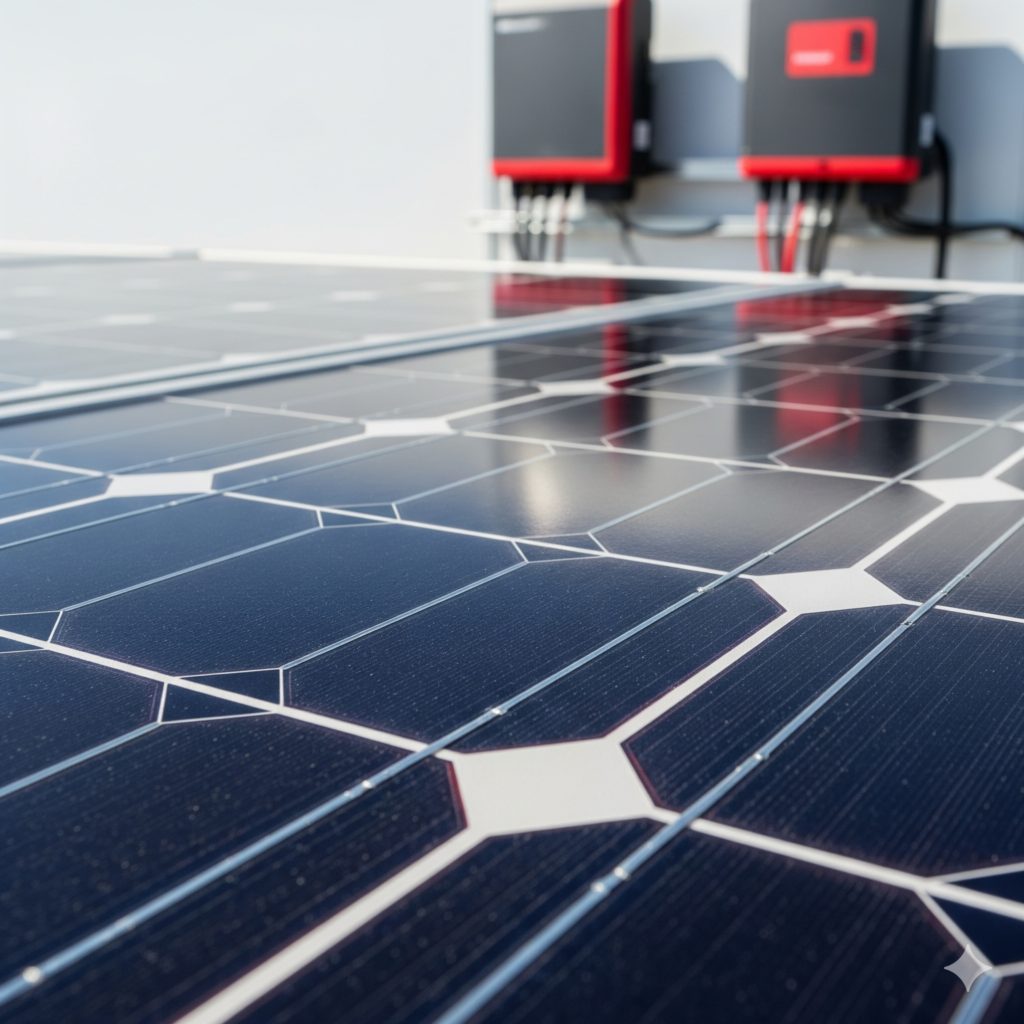
Solar energy has evolved into the cheapest power source in history. This post unpacks the engineering behind Photovoltaics (PV), from irradiance data and temperature coefficients to emerging technologies like bifacial panels and perovskites. Learn how to optimize system design and maximize energy…
Introduction
Solar energy has evolved from a niche space-exploration technology to the cheapest source of electricity in history. But for engineers and project managers, understanding “solar” goes beyond simply installing panels. It requires a grasp of Photovoltaic (PV) physics, irradiance data, and the balance of system (BoS) components. In this post, we unpack the technical fundamentals of Solar PV.
Purpose: Harvesting the Sun
Solar PV converts sunlight directly into electricity using the photovoltaic effect. The goal is simple: maximize the conversion of solar irradiance (W/m²) into usable electrical power (kWh), while minimizing losses due to heat, resistance, and shading.
Inputs: The Physics of Efficiency
- Irradiance: The power of solar radiation per unit area. Standard Test Conditions (STC) assume 1000 W/m², but real-world engineering must account for local DNI (Direct Normal Irradiance) and GHI (Global Horizontal Irradiance).
- The Semiconductor: Most panels use silicon. When photons hit the silicon cell, they knock electrons loose, creating a current.
- Temperature Coefficient: Ironically, solar panels hate heat. As temperature rises, voltage drops, reducing efficiency. High-quality panels have a lower temperature coefficient (e.g., -0.3%/°C).
Process Steps: Designing a Solar Solution
- Site Assessment: Using tools like PVSyst or Helioscope to model shading and sun path.
- Component Selection: Choosing between Monocrystalline (higher efficiency, higher cost) vs. Polycrystalline (lower cost, larger footprint).
- Inverter Configuration: Matching string voltage to the inverter’s MPPT (Maximum Power Point Tracking) window to ensure optimal energy harvest.
- Racking & Mounting: Engineering the structural load to withstand wind uplift and snow loads.
Emerging Technologies
- Bifacial Panels: These capture reflected light (albedo) from the ground on the rear side of the panel, boosting output by 5-30%.
- Perovskites: A new class of materials that promises higher efficiency layers that can be printed or painted, potentially disrupting the silicon market.
Common Pitfalls
- Ignoring Soiling: Dust and bird droppings can cause “hot spots” that damage cells and reduce string output.
- Undersizing Inverters: While some “clipping” (overloading the inverter) is acceptable to maximize early morning/late afternoon production, excessive DC/AC ratios reduce equipment life.
Example: The Utility-Scale Shift
Consider a 100MW solar farm in a desert region. By switching from fixed-tilt racking to Single-Axis Trackers (which follow the sun east-to-west), the project increased its energy yield by 25%, significantly lowering the Levelized Cost of Energy (LCOE) despite the higher mechanical CAPEX.